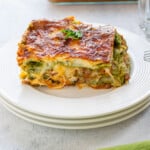
Authentic Lasagna Bolognese
Featuring layers of homemade spinach pasta, béchamel sauce, cheese and Bolognese sauce, this will be one of the best meals of your life!
Servings: 10
Calories: 809kcal
Ingredients
Bolognese Sauce
- 1 medium or large onion (chopped)
- 4 medium carrots (diced small)
- 2 large celery stalks (diced small)
- 4 cloves garlic (chopped finely)
- 4 tablespoons salted butter
- 2 tablespoons olive oil
- 1 pound ground sweet Italian sausage (can use hot sausage for a spicy dish)
- 1 pound lean ground beef (85% or 90% works well)
- 1 cup white wine (Sauvignon Blanc works well, but red can be used)
- 6 ounces tomato paste
- 1 ½ cups beef stock
- ½ cup half and half (can use fat-free if needed)
- 1 pinch salt
- ⅛ teaspoon black pepper
- 4-8 fresh basil leaves
Spinach Pasta Sheets (1.5 pounds)
- 10 ounces frozen, chopped spinach (thawed, drained and squeezed dry)
- 400 grams all-purpose flour, ideally King Arthur (14.1 ounces, which is 3 ⅓ cups.)
- 4 extra-large eggs
- 1 pinch salt
Béchamel Sauce
- 2 cups whole milk (warmed)
- 1 garlic clove (medium)
- 4 Tablespoons salted butter
- 4 Tablespoons all-purpose flour
- ⅛ teaspoon salt
- ⅛ teaspoon pepper
- 4 fresh basil leaves (medium)
For the Lasagna
- 1 ½ cups grated Pecorino Romano
- 1 pound mozzarella cheese (shredded)
Instructions
BOLOGNESE SAUCE (1 hour, 25 mins.)
- Peel and chop the onion and set it aside.
- Rinse the carrots, peel them, and trim off the ends. Dice the carrots. Rinse the celery, scrub off any dirt, and dice the celery.
- Peel and chop the garlic finely.
- Melt the butter with the oil in a 12-inch skillet over medium-high heat. Add the onion, carrots, celery and garlic and stir to combine. Cook this "soffritto" until it's tender. Make sure the carrots are soft.
- Stir in the ground beef and sausage, breaking up the meat with a wooden spoon. Cook over medium heat, stirring occasionally, until the meat is no longer pink. (If you see lots of liquid, you can drain some. Leave some for flavor.)
- Stir in the wine (use a clean spoon) and let it come to a boil. Reduce the heat and simmer for five minutes, until the wine is evaporated.
- Stir in the tomato paste, beef stock, half-and-half, salt and pepper. Heat until boiling, then reduce the heat to a simmer. Cover the pot, propping the lid open by leaving a wooden spoon resting on the edges of the pot.
- Simmer 45 minutes, stirring occasionally.
- Tightly roll up a couple of basil leaves at a time into a long cylinder. Use kitchen scissors or a small knife to cut them into thin ribbons. Stir the basil into the sauce when it's done. Taste the Bolognese to see if additional salt and pepper are needed.
- Store leftover sauce in the refrigerator for up to four days.
SPINACH PASTA SHEETS (18 mins. prep + 30 mins. rest)
- Thaw the spinach in the microwave. (Take it out of the package and place the greens in a microwave-safe bowl, loosely covered. Heat the spinach on high for 2 minutes and 40 seconds or up to 3 minutes, until thawed.)
- Drain the spinach in a fine mesh strainer or colander in the sink. Use a fork to press the liquid out of the spinach. Let it sit to dry and cool. Before using the spinach, pat it dry and squeeze it with paper towels or a lint-free kitchen towel, until the liquid is gone.
Using a stand mixer with dough hooks (recommended)
- Add the flour and salt to the bowl of a stand mixer fitted with dough hooks. Add the eggs and dried, thawed spinach. Mix on the lowest speed just until combined. Then increase the speed slightly (speed 2 on a Kitchenaid) to knead the dough for six minutes. It may look dry at first, but do not add any water to the mixture. Eventually, the dough will gather into a ball that pulls away from the sides of the bowl.
- Transfer the dough to a clean surface dusted with flour. Use your hands to knead the dough for a couple of minutes, until it's smooth. Let the dough rest for 30 minutes at room temperature, covered with a kitchen towel or mixing bowl.
- After the dough has rested, cut it into four equal parts. (Cut it in half, then cut those pieces in half.) Take one of the fourths of dough to work with, leaving the rest covered loosely with a sheet of wax paper or a lint-free kitchen towel.
Making the pasta dough by hand
- If you don't have a stand mixer or food processor (see notes), you can make the dough by hand. Place the flour on a clean surface. Stir in the salt with a fork. Push the flour to the sides with the fork, forming a circle of flour with a well in the center.
- Crack the eggs into the center of the circle. Beat the eggs with the fork and stir the dried, chopped spinach into the eggs. Gently push a little flour at a time into the egg mixture and stir. Continue this way until all of the flour is mixed in.
- Knead the dough for about seven minutes, or until it is smooth. (You'll have to use the bottom of the palms of your hands to push the dough forward, fold it toward you, rotate it, then push it again.) Shape the dough into a ball, cover it, and let it rest for 30 minutes at room temperature.
Rolling with a pasta machine or pasta attachment on a stand mixer
- Set up the pasta machine or stand mixer attachment according to the instructions on your equipment. Starting at the widest setting, feed the piece of dough into the machine, turning the handle as you go. When it comes out of the rollers, the dough will be flatter but have rounded edges. Take each rounded end and fold it toward the middle of the dough sheet, just until the edges are straight and the dough has a rectanglular shape. Feed it through the machine again.
- Change the setting on the machine to the next level that's a bit more narrow. Feed the dough through the machine two times at this level. When the dough rectangle gets long, use kitchen scissors or a dough cutter to cut the dough in half so you have two strips of dough.
- Adjust the machine to the next level that's narrower. Roll each strip of dough twice at this level, then twice on the setting after that. (Use four levels total or until you have your desired thickness.) The dough will be thinner as you go. If it tears, you're rolling it too thin. Fold it and run it through on the next wider setting.) Place the rolled pasta sheets on a floured baking sheet, sprinkle them with flour and cover them with wax paper.
- Take the next quarter of dough and repeat as above. You can stack the green pasta sheets between layers of wax paper, making sure you sprinkle flour on the pasta before covering it. Continue rolling the rest of the dough as above. Wait to cook the pasta until you've made the Bolognese and béchamel sauces and you're ready to assemble the lasagna. The pasta sheets can stay at room temperature for up to two hours and should be refrigerated if you need more time before cooking them.
BECHAMEL SAUCE (10 mins.)
- Heat the milk in a microwave-safe cup or bowl for 50 seconds, or just until it's warm. Peel the clove of garlic and cut it into three pieces.
- In a small or medium saucepan, melt the butter over medium-high heat. Add the flour, whisk to combine and continue whisking and cooking the flour mixture for a minute. Lower the heat if it bubbles too much.
- Slowly add the warmed milk, a little at a time, whisking it in as you go. Add the garlic, salt and pepper. Use a wooden spoon to stir the sauce over medium-high heat for 3 minutes, or until it's thick and smooth. It's ready when you can push the spoon through it and see the bottom of the pan. Turn off the heat and remove the garlic.
- Cut or tear the basil leaves into small pieces and stir them into the sauce.
- If you're not going to use the béchamel immediately, place a layer of wax paper or plastic wrap on its surface, so a film doesn't form. The sauce can sit at room temperature for up to two hours, then it needs to be refrigerated.
PARBOIL THE PASTA SHEETS & ASSEMBLE THE LASAGNA (25 mins.)
- This makes five layers that fit nicely in a deep-dish, 9x13 lasagna pan. If you don't have a deep-dish pan, you can put 3 or 4 layers in a regular 9x13 pan and the rest in a loaf pan or 8x8 square pan.
- Preheat the oven to 400 degrees F. Grate the Pecorino (you can use a blender if you wish.) Shred the mozzarella or grate it in a blender.
- Fill a large pasta pot ⅔ full with hot water, add salt and place it covered, over high heat on the stove.
- Add two ladles (1 cup) of Bolognese sauce to the bottom of a deep-dish, 9x13 lasagna pan (ideally) or a regular 9x13 pan.
- When the water is boiling, add two pasta sheets to the pot. Cook the pasta for 90 seconds, then use tongs to hold up the pasta to drip excess water into the pot, then transfer the parboiled pasta to the lasagna pan, laying them the long way, next to each other on top of the Bolognese sauce.
- Add two ladles of Bolognese sauce on top of the spinach noodles in the lasagna pan. Use a scoop or tablespoon to add dollops of some bechamel sauce on the layer of pasta. Sprinkle on ⅕ of the grated Pecorino and ⅕ of the mozzarella.
- Add two more sheets of pasta to the pot of boiling water. Cook them for 90 seconds, then use tongs to place them next to each other across the lasagna pan. (You don't need to criss-cross the layers, so there is no need to cut the lasagna noodles. Just lay them down the long way.)
- Add two ladles of Bolognese sauce, dollops of some bechamel sauce, and handfuls of Pecorino and mozzarella. Continue boiling two sheets of pasta at a time for 90 seconds, removing them with tongs and assembling the lasagna as you go. There will be five layers of pasta.
- For the top layer, don't use Bolognese. Just add the pasta sheets, spread on the rest of the bechamel, and sprinkle on the rest of the Pecorino and mozzarella.
- Bake the lasagna on the center rack of your oven for 20-25 minutes, or until it's bubbly and the top is browned. If you're using a deep-dish lasagna pan, you don't need to cover the pan while baking. If you have a regular 9x13, grease some foil with cooking spray and cover the pan before baking it so it won't bubble over.
- Let the lasagna rest for 10 minutes before cutting it. Serve each portion with some Bolognese sauce spooned on top. Store leftovers in the refrigerator for up to four days, or freeze them.
Notes
If using dried, store-bought, plain lasagna noodles: Boil the pasta for just a little more than half of the al dente cooking time on the package. Drain, then drape them over the colander and pot until you're ready to assemble the lasagna.
Making the pasta dough in a food processor: If you don't have a stand mixer with dough hooks, you can mix the dough in a food processor. Add the dried spinach and eggs to the bowl. Pulse briefly just until blended, then add the flour and run the processor until the dough comes together. Knead the dough by hand for a couple of minutes, or until smooth.
To Freeze Baked Lasagna: Let it cool off first. It's best to freeze it in portions so you can thaw the amount you need. Freeze the portions in a zip-top freezer bag and reheat them in the microwave.
To Freeze Unbaked Lasagna: Make sure it's cooled off. To freeze, cover the pan of assembled lasagna well with heavy foil, then thaw it overnight in the refrigerator before baking it.
Make-Ahead Tips
You can make Authentic Lasagna Bolognese all in one day, but it's easier to start the day before. You can choose to do any or all of the following ahead of time
- Make the Bolognese sauce a day ahead. It takes 85 minutes.
- While the Bolognese is cooking, you can grate the Pecorino and shred the mozzarella. Refrigerate the cheeses in sealed containers in the refrigerator so they'll be ready for the next day.
- You can make the spinach dough, which takes 20 minutes. It needs to stay at room temperature for 30 minutes, then you can wrap it and refrigerate it overnight.
- You can make and assemble the lasagna without baking it. Cover it tightly and refrigerate it until the next day. Take it out of the refrigerator for 30 minutes before baking it as directed.
- I don't recommend making the béchamel the day before unless you're going to assemble the lasagna a day ahead. Storing béchamel by itself in the refrigerator can cause it to separate, and you'd have to reconstitute it on the stove before using it. It takes just 10 minutes to make the white sauce, so you might as well do it the same day you're assembling the lasagna
Nutrition
Calories: 809kcal | Carbohydrates: 47g | Protein: 43g | Fat: 48g | Saturated Fat: 23g | Polyunsaturated Fat: 4g | Monounsaturated Fat: 17g | Trans Fat: 1g | Cholesterol: 214mg | Sodium: 1233mg | Potassium: 939mg | Fiber: 4g | Sugar: 8g | Vitamin A: 8548IU | Vitamin C: 9mg | Calcium: 555mg | Iron: 6mg
