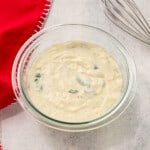
Béchamel Sauce for Lasagna
Use this creamy béchamel sauce in lasagna Bolognese and more! It's so easy, and you'll love the accents of garlic and basil.
Servings: 10 (Makes enough for 9x13 lasagna)
Calories: 81kcal
Ingredients
- 2 cups whole milk (warmed)
- 1 garlic clove (medium)
- 4 Tablespoons salted butter
- 4 Tablespoons all-purpose flour
- ⅛ teaspoon salt
- ⅛ teaspoon pepper
- 4 fresh basil leaves (medium)
Instructions
- Heat the milk in a microwave-safe cup or bowl for 50 seconds, or just until it's warm. Peel the clove of garlic and cut it into three pieces.
- In a small or medium saucepan, melt the butter over medium-high heat. Add the flour, whisk to combine and continue whisking and cooking the flour mixture for a minute. Lower the heat if it bubbles too much.
- Slowly add the warmed milk, a little at a time, whisking it in as you go. Add the garlic, salt and pepper. Use a wooden spoon to stir the sauce over medium-high heat for 3 minutes, or until it's thick and smooth. It's ready when you can push the spoon through it and see the bottom of the pan. Turn off the heat and remove the garlic.
- Cut or tear the basil leaves into small pieces and stir them into the sauce.
- If you're not going to use the béchamel immediately, place a layer of wax paper or plastic wrap on its surface, so a film doesn't form. The sauce can sit at room temperature for up to two hours, then it needs to be refrigerated. It can be refrigerated in a tightly sealed container for 3-4 days.
Notes
Adding Nutmeg:
- We don't use nutmeg in our béchamel sauce, even though it's traditional. If you don't mind its flavor, you can add some. Start with ⅛ teaspoon and stir it in, then taste the sauce to see if you want to add more.
- To reheat béchamel sauce by itself, place it in a pot on the stove over low heat. Whisk constantly to prevent lumps, until it's heated through. This will give you a smoother result than using the microwave.
- Once the béchamel is used in lasagna, however, you can reheat the lasagna in the microwave with no problem.
- You can freeze béchamel sauce for up to three months, but it will separate. Thaw it overnight in the refrigerator, then add it to a pot on the stove to reheat it. Whisk it constantly over low heat, and it should reconstitute.
Nutrition
Calories: 81kcal | Carbohydrates: 5g | Protein: 2g | Fat: 6g | Saturated Fat: 4g | Polyunsaturated Fat: 0.2g | Monounsaturated Fat: 2g | Trans Fat: 0.2g | Cholesterol: 18mg | Sodium: 84mg | Potassium: 80mg | Fiber: 0.1g | Sugar: 2g | Vitamin A: 228IU | Vitamin C: 0.1mg | Calcium: 63mg | Iron: 0.2mg
