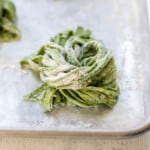
Homemade Spinach Pasta Dough
Make this delicious Spinach Pasta Dough to use for lasagna, fettuccine, tagliatelle and more!
Servings: 9 Makes 1.5 pounds
Calories: 199kcal
Equipment
Ingredients
- 10 ounces frozen, chopped spinach (Thawed. See notes.)
- 400 grams all-purpose flour, ideally King Arthur (14.1 ounces, which is 3 ⅓ cups.)
- 4 extra-large eggs
- 1 pinch salt
Instructions
- Thaw the spinach in the microwave. (Take it out of the package and place the greens in a microwave-safe bowl, loosely covered. Heat the spinach on high for 2 minutes and 40 seconds or up to 3 minutes, until thawed.)
- Drain the spinach in a fine mesh strainer or colander in the sink. Use a fork to press the liquid out of the spinach. Let it sit to dry and cool. Before using the spinach, pat it dry and squeeze it with paper towels or a lint-free kitchen towel, until the liquid is gone.
Using a stand mixer with dough hooks (recommended)
- Add the flour and salt to the bowl of a stand mixer fitted with dough hooks. Add the eggs and dried, thawed spinach. Mix on the lowest speed just until combined. Then increase the speed slightly (speed 2 on a Kitchenaid) to knead the dough for six minutes. It may look dry at first, but do not add any water to the mixture. Eventually, the dough will gather into a ball that pulls away from the sides of the bowl.
- Transfer the dough to a clean surface dusted with flour. Use your hands to knead the dough for a couple of minutes, until it's smooth. Let the dough rest for 30 minutes at room temperature, covered with a kitchen towel or mixing bowl.
- After the dough has rested, cut it into four equal parts. (Cut it in half, then cut those pieces in half.) Take one of the fourths of dough to work with, leaving the rest covered loosely with a sheet of wax paper or a lint-free kitchen towel.
Making the pasta dough by hand
- If you don't have a stand mixer or food processor (see notes), you can make the dough by hand. Place the flour on a clean surface. Stir in the salt with a fork. Push the flour to the sides with the fork, forming a circle of flour with a well in the center.
- Crack the eggs into the center of the circle. Beat the eggs with the fork and stir the dried, chopped spinach into the eggs. Gently push a little flour at a time into the egg mixture and stir. Continue this way until all of the flour is mixed in.
- Knead the dough for about seven minutes, or until it is smooth. (You'll have to use the bottom of the palms of your hands to push the dough forward, fold it toward you, rotate it, then push it again.) Shape the dough into a ball, cover it, and let it rest for 30 minutes at room temperature.
Rolling with a pasta machine or pasta attachment on a stand mixer
- Set up the pasta machine or stand mixer attachment according to the instructions on your equipment. Starting at the widest setting, feed the piece of dough into the machine, turning the handle as you go. When it comes out of the rollers, the dough will be flatter but have rounded edges. Take each rounded end and fold it toward the middle of the dough sheet, just until the edges are straight and the dough has a rectanglular shape. Feed it through the machine again.
- Change the setting on the machine to the next level that's a bit more narrow. Feed the dough through the machine two times at this level. When the dough rectangle gets long, use kitchen scissors or a dough cutter to cut the dough in half so you have two strips of dough.
- Adjust the machine to the next level that's narrower. Roll each strip of dough twice at this level, then twice on the setting after that. (Use four levels total or until you have your desired thickness.) The dough will be thinner as you go. If it tears, you're rolling it too thin. Fold it and run it through on the next wider setting.) Place the rolled pasta sheets on a floured baking sheet, sprinkle them with flour and cover them with wax paper.
- Take the next quarter of dough and repeat as above. You can stack the green pasta sheets between layers of wax paper, making sure you sprinkle flour on the pasta before covering it. Continue rolling the rest of the dough as above. You can use the spinach pasta sheets for lasagna or ravioli now or make fettuccine or tagliatelle as in the next step.
For Homemade Spinach Fettuccine
- When your pasta sheets are rolled out, set up the fettuccine (or tagliatelle attachment) on your pasta machine or stand mixer. Feed the floured pasta sheets through the machine, which will cut them into narrow strips of spinach pasta.
- Place the spinach fettuccine on a flour-dusted baking sheet. Sprinkle the homemade pasta with flour, then cover with wax paper. Make layers as you go. See the notes section about storing uncooked pasta.
To cook lasagna sheets
- Add two pasta sheets at a time to a large pot of boiling, salted water. Cook the pasta for 90 seconds, then use tongs to transfer the parboiled pasta to a 9x13 pan to assemble the lasagna, placing the strips next to each other across the pan. Continue boiling two sheets of pasta at a time for 90 seconds, removing with tongs, assembling the lasagna as you go. When you're done assembling the lasagna, bake it as directed in the lasagna recipe you're using.
To cook spinach fettuccine or tagliatelle
- Add all of the spinach noodles to a large pot of boiling, salted water. Stir with a pasta fork as needed to separate the strands. Cook the fresh pasta for four minutes or until it's al dente. Drain it in a colander in the sink. Mix it with butter and cheese or any pasta sauce.
- Store leftover cooked fettuccine in the refrigerator for up to four days, covered tightly.
- To store uncooked spinach fettuccine, portion it out in serving amounts and pile it into pasta nests on a floured baking sheet. Sprinkle with flour, cover and refrigerate for 1-2 days. Or freeze the pasta nests for up to three months. (See notes.)
Notes
It takes less than 20 minutes to make the dough, then it needs to rest for 30 minutes. Rolling it out into pasta sheets takes about 16 minutes.
Spinach: Using frozen, chopped spinach is much easier than using fresh spinach. You'll need to thaw the frozen spinach in the microwave and squeeze out all of the water.
If you prefer, you can use one pound of fresh spinach. You'll need to wash it, remove its stems, boil it for one minute for baby leaves or 2-4 minutes for larger leaves. Then you'll need to drain it, chop it and squeeze out the water.
Making the dough in a food processor: If you don't have a stand mixer with dough hooks, you can mix the dough in a food processor. Add the dried spinach and eggs to the bowl. Pulse briefly just until blended, then add the flour and run the processor until the dough comes together. Knead the dough by hand for a couple of minutes, or until smooth.
Make Ahead: You can make the dough one day ahead, wrap it with plastic wrap and refrigerate it. Let it come to room temperature for 30 minutes before rolling it.
To freeze, it's better to roll the dough out first and cut it into your desired pasta shape. Flour the fresh spinach pasta well and freeze it in a zip-top bag or airtight container for up to three months. For long pasta, pile it into nests before freezing it.
Cooking frozen pasta: You can cook frozen spinach fettuccine without thawing it first. Cook the pasta nests in boiling salted water for six minutes, or just until al dente. Use a fork to separate the pasta strands as they cook.
See the article that goes with this post for step-by-step photos and further information.
Nutrition
Calories: 199kcal | Carbohydrates: 35g | Protein: 8g | Fat: 2g | Saturated Fat: 1g | Polyunsaturated Fat: 1g | Monounsaturated Fat: 1g | Trans Fat: 0.01g | Cholesterol: 73mg | Sodium: 56mg | Potassium: 183mg | Fiber: 2g | Sugar: 0.4g | Vitamin A: 3799IU | Vitamin C: 2mg | Calcium: 58mg | Iron: 3mg
