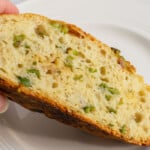
No-Knead Olive Bread
Featuring Italian olives and roasted garlic, this No-Knead Olive Bread has a crispy crust and a flavorful, plush texture. Start it the night before you want to bake it.
Servings: 10 Makes 1 loaf
Calories: 207kcal
Ingredients
- 3 ⅓ cups bread flour (430 grams; can use all-purpose flour)
- 2 teaspoons sugar
- 1 ¼ teaspoons salt
- ½ teaspoon instant yeast (can use active without proofing it)
- ¼ teaspoon black pepper
- 1 cup room-temperature water
- ½ cup olive brine (room temperature)
- 1 Tablespoon olive oil
- 6.75 ounces pitted Castelvetrano green olives (195 grams, drained. A little more than ¾ cup of olives.)
Roasted Garlic
- 1 head garlic cloves (medium-to-large size)
- 2 teaspoons olive oil
Instructions
The Night Before - Make the Dough
- Set aside ½ cup of brine from the jar of olives.
- Coarsely chop the olives. Refrigerate any extra olives and brine for another use.
- In a large mixing bowl, add the flour, sugar, salt, yeast and pepper. Stir with a spoon to combine. Pour in the water, olive oil and brine. Add the chopped, drained olives. Stir with a wooden spoon until combined. The dough will be sticky. Use your hands to bring it together into a ball.
- Lift up the dough and grease your mixing bowl with cooking spray (you can use the same bowl without cleaning it first.) Place the dough back in the greased bowl and roll it around to coat it with the oil. Cover the bowl with plastic wrap and let the dough rise for 12-18 hours at room temperature.
Baking Day - Roast the Garlic
- Preheat the oven to 400 degrees F. Remove the outer, papery skin from the head of garlic, using your fingers or a small knife if needed. (Leave the skin on each garlic clove.) Use a sharp knife to slice off ¼-inch across the top of the head (not the root end) to expose the cloves.
- Place the head of garlic on a sheet of foil or in a muffin tin. Drizzle two teaspoons of oil on the garlic. If you used a sheet of foil, close it around the garlic. If you used a muffin pan, cover the entire pan with foil. (See notes if you want to roast extra garlic for another use.)
- Roast the garlic for 30-40 minutes, until lightly browned. The cloves should be soft. Use tongs to transfer the garlic to a cutting board to cool. Turn off the oven.
- Once the garlic has cooled, use a small knife to cut the skin slightly around each clove from one head of garlic. Squeeze out the roasted garlic cloves. Discard the skin and chop the cloves. Proceed to fold the dough as directed below.
Baking Day - Fold, Rise and Bake
- When the dough has risen, it will be puffy, soft, and very sticky. Grease a sheet of parchment paper, along its entire surface (edge to edge), with cooking spray. (If using the parchment sold as pre-cut sheets, use two of them, overlapping with the surface fully greased, so you have enough to use as handles around the dough.) Scrape down the sides of the bowl and gently transfer the dough to the center of the greased parchment paper.
- Lightly sprinkle some flour on the dough so it's easier to work with. Lightly spray your hands with cooking spray and pat the dough into a thick, rectangular shape. Add the chopped, roasted garlic in an even layer on top of the dough.
- Flour your hands so it's easier to work with the dough. Starting at the top, long edge of the dough fold the top half toward you, over the middle (you can pull the top edges of the parchment paper toward you to help fold the dough, then peel the paper back into place.) Fold the bottom half of the dough over the top fold. Fold the left side toward the center. Fold the right side toward the middle as well.
- Flip over the folded dough so the seams are on the bottom. Clean your hands and cover the dough with lightly greased plastic wrap. Let it rise on the counter for two hours at room temperature.
- When the dough has 30 minutes left to rise, remove the top rack of the oven so there is plenty of space above the middle rack. Place a (6-to 8-quart) cast iron or enameled Dutch oven, covered with its lid, on the middle rack. Preheat the oven to 450 degrees F.
- When the dough is finished rising, remove the pot from the oven and take off the lid. Use the corners of the parchment paper as handles to lift the dough into the pot, along with the parchment paper. Score the dough with a sharp knife, making two slits in the shape of an X. Cover with the lid and bake for 30 minutes initially.
- Then, remove the lid and bake the bread for 15-25 minutes longer, until the top is browned nicely. Use the corners of the parchment paper as handles to lift the bread out of the pot and transfer it to a wire rack to cool. You can tap the bottom of the loaf to make sure it sounds hollow. If not, it needs to bake a little longer. Cool the bread without the parchment paper.
- Store the cooled bread at room temperature, wrapped in plastic and then placed in a brown bag. It's best eaten by the next day or so for freshness. For longer storage, it's best to slice the loaf the first day and freeze it in a freezer bag.
Notes
- If you use active dry yeast, you don't need to proof it first because of the long rising time.
- You just need one head of garlic for the dough, but you may want to roast extra garlic for another use. After removing the papery outer skin, you can place each head of garlic in the well of a muffin pan. Drizzle two teaspoons of oil on each head of garlic. Cover the pan with foil and bake as directed.
- Make sure to grease the parchment paper well from edge to edge, so it doesn't stick to the baked loaf.
- The dough will be very sticky. Do your best to fold it as directed, but it doesn't need to be perfect.
- If the lid on your Dutch oven pot has a plastic or rubber handle, wrap the handle in foil before using it in this recipe.
Nutrition
Calories: 207kcal | Carbohydrates: 33g | Protein: 6g | Fat: 6g | Saturated Fat: 1g | Polyunsaturated Fat: 1g | Monounsaturated Fat: 4g | Sodium: 935mg | Potassium: 67mg | Fiber: 2g | Sugar: 1g | Vitamin A: 77IU | Vitamin C: 1mg | Calcium: 23mg | Iron: 1mg
